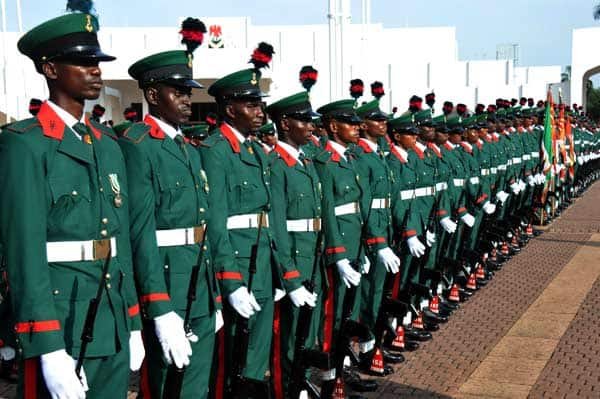
Nigerian Army SSC Recruitment and Requirements.
For Nigerian graduates who want to serve their country in uniform without signing up for a lifetime military career, the Short Service Combatant Commission offers a fairly appealing middle ground. It’s a route into the Nigerian Army built specifically for degree and HND holders who want to serve as commissioned officers on a fixed, defined term rather than a career that stretches across decades. If this pathway has caught your attention, here’s a clear breakdown of what it involves and what you need to qualify.
Let’s start with what SSC actually stands for and how it differs from other entry routes. Short Service Combatant Commission recruitment runs once a year, and it’s aimed squarely at graduates who want a shot at serving in the Army’s combat and combat-support units, things like Infantry, Armour, Artillery, Engineers, Signals, and Intelligence Corps.
Read also: Immigration Salary for Graduate and Rank
Nigerian Army SSC Recruitment and Requirements
It’s worth noting that SSC often gets confused with a similar programme called DSSC, or Direct Short Service Commission. Both target graduates and both lead to a commission, but they aren’t identical tracks, and the eligibility details differ slightly between them, so it pays to be clear on which one you’re actually applying for before you start filling out forms.
Now onto the requirements, since this is where most applicants want clarity. Nationality comes first, and it’s completely non-negotiable: you must be a Nigerian citizen by birth, in line with the constitutional provisions governing citizenship. Age is another firm boundary. For the SSC route specifically, applicants generally need to fall between 23 and 27 years old as of the stated cutoff date tied to that year’s recruitment cycle, so it’s worth checking the exact date attached to whichever course is currently open rather than assuming last year’s window applies unchanged.
Academic qualification is where the SSC route really distinguishes itself from general enlistment. You’ll need a minimum of a first degree with at least a Second Class Lower division, or an HND with at least a Lower Credit, from an accredited institution, and this applies across disciplines in the arts, sciences, and humanities. Marital status matters too. Applicants are expected to be single at the point of application, which is a detail some candidates overlook until it trips them up during screening.
Physical and medical standards carry real weight in this process. You’ll need to meet the Army’s height requirement, generally a minimum of around 1.68 metres for men and 1.65 metres for women, and you must be certified medically, mentally, and physically fit according to the standards the Army applies across the board. Character references form another key part of the file. Civilian applicants are typically required to submit attestation letters from two credible referees, and these can’t just be anyone. The Army usually specifies that referees should hold a certain level of standing, such as a Local Government Chairman or Secretary, or a senior military or police officer at a rank no lower than Lieutenant Colonel or Assistant Commissioner of Police. If you’re already serving in the Armed Forces or have served previously, the application process accounts for that separately, since serving personnel, soldiers, ratings, and airmen are also eligible to apply through this same window.
On the application process itself, everything runs through the Nigerian Army’s official recruitment portal, and this is a point worth repeating because it matters: the application is completely free, and no legitimate step in this process will ever ask you for payment. The Army has been explicit about warning applicants to ignore any unofficial portal or third party claiming to offer a shortcut, and anyone demanding money in exchange for a guaranteed slot is running a scam. Once you’re on the genuine portal, you’ll select the SSC option, review the conditions of entry for that specific course, and click through to apply based on your qualification. If you’re a first-time applicant, you’ll need to create an account and verify it through an email link before you can proceed. From there, the form asks whether you’re currently serving or have previously served in the Armed Forces, and you’ll need to upload clear, valid copies of your supporting documents alongside the completed application.
Once applications close, the Army reviews submissions and puts out a shortlist, and only candidates who appear on it move forward into screening and assessment. Those who make it through this stage are eventually invited into training, which for SSC cadets runs for about nine months at the Nigerian Army Training Centre. Successful completion of that training leads to commissioning as a Second Lieutenant, at which point you officially step into your role as a commissioned officer. It’s also worth knowing that the commitment attached to this commission isn’t indefinite. Officers typically serve an initial term of several years on the active list, which in some cases can be renewed, so it’s a meaningful commitment but not an unlimited one, which is part of what makes SSC attractive to graduates who want military service without locking themselves into it permanently.
One more thing worth flagging for anyone getting ready to apply: it’s generally possible for SSC officers to later apply for conversion into a Regular Combatant Commission, though this isn’t automatic and depends on available vacancies and other conditions the Army sets at the time.
If you meet the qualifications and the timeline works for you, this is genuinely one of the more structured and respected ways for a Nigerian graduate to serve in a leadership capacity within the military. Get your documents, referee letters, and academic records in order ahead of time, watch the official recruitment portal for the next course announcement, and go in prepared rather than rushing to assemble everything after the window has already opened.










1 thought on “Nigerian Army SSC Recruitment and Requirements”