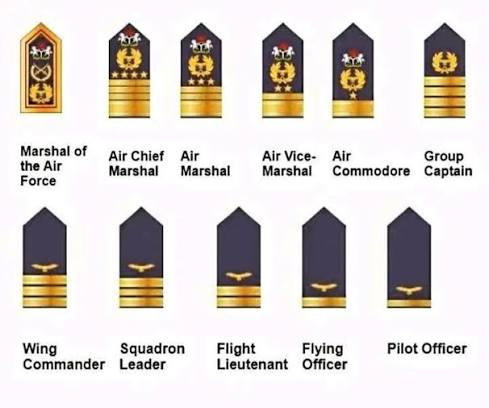
Nigerian air force ranks and symbols insignia.
The Nigerian Air Force (NAF) operates under a highly organized hierarchical structure designed to manage airspace defense, tactical air operations, and domestic security assignments. To maintain discipline and clarity in command, personnel are explicitly divided into two major categories: Commissioned Officers and Non-Commissioned Officers (NCOs) / Enlisted Personnel.
Each rank is distinguished by a specific set of symbols and insignia worn on uniform epaulettes, sleeves, or caps. These symbols draw heavily on British Royal Air Force traditions while proudly incorporating Nigerian national emblems like the Eagle and the Coat of Arms.
Read also: £28K UK Cleaning Jobs for Foreigners With Visa Sponsorship: What You Need to Know
Nigerian air force ranks and symbols insignia
Commissioned officers represent the leadership, piloting, and administrative core of the air force. They enter service via the Nigerian Defence Academy (NDA) or the Direct Short Service Commission (DSSC).
Their insignia primarily consist of light blue and dark blue braided bars (rings) worn on sleeves or epaulettes, transitioning to elaborate combinations of crossed swords, eagles, and stars for high-level commanders.
Junior Officers
- Pilot Officer: The initial entry rank for fresh academy graduates. The insignia features a single, thin light-blue band bordered by dark blue stripes on the shoulder epaulette.
- Flying Officer: A rank typically attained after one to two years of active service. The symbol consists of one standard-width light-blue band.
- Flight Lieutenant: A fully established junior officer rank responsible for flight sections or tactical units. The insignia displays two parallel standard-width blue bands.
Senior Officers
- Squadron Leader: The first tier of senior command. The symbol features a narrow blue band positioned directly between two standard-width blue bands.
- Wing Commander: A highly senior operational rank. The insignia consists of three parallel standard-width blue bands.
- Group Captain: Responsible for directing air groups or air force bases. The symbol features four parallel standard-width blue bands.
Air Officers (Generals)
- Air Commodore: The first star-general rank. The insignia consists of a single, exceptionally broad blue band on the sleeve, or a shoulder epaulette bearing a national eagle and one star.
- Air Vice Marshal (AVM): A high-level command rank equivalent to a Major General in the army. The insignia displays a broad blue band alongside one standard band on the sleeve, or a shoulder board with a crossed sword and baton, the national eagle, and two stars.
- Air Marshal: Typically the rank held by the Chief of Air Staff (CAS). The symbol features a broad blue band and two standard bands on the sleeve, or a shoulder board with the national eagle, crossed weapons, and three stars.
- Air Chief Marshal: A rare four-star general rank usually reserved for an Air Force officer appointed as the Chief of Defence Staff (CDS). The insignia consists of a broad blue band and three standard bands, or a shoulder board with the national eagle, crossed weapons, and four stars.
- Marshal of the Nigerian Air Force: A five-star supreme honorary or wartime rank. The symbol features intricate gold and blue embroidery with specialized leaf patterns, the national coat of arms, and five stars.
Non-Commissioned Officers (NCOs) and Enlisted Insignia
Enlisted airmen and airwomen represent the technical, maintenance, ground security, and tactical support framework of the service. Their ranks are primarily denoted by cloth chevrons (V-shaped bars), eagles, and coats of arms worn on the upper arms or shoulders of their uniforms.
- Aircraftman / Aircraftwoman: The basic entry-level rank for fresh recruits straight out of the Military Training Centre. This rank features no specialized sleeve insignia or chevrons.
- Leading Aircraftman: Awarded after gaining foundational experience. The insignia features a single downward-pointing cloth chevron or propellor symbol depending on their technical branch.
- Corporal: A junior non-commissioned officer leading small ground teams. The symbol consists of two downward-pointing chevrons.
- Sergeant: A senior technical and squad supervisor. The insignia features three downward-pointing chevrons.
- Flight Sergeant: A highly experienced supervisor within air wings or administrative departments. The symbol displays three downward-pointing chevrons topped by a soaring eagle.
- Warrant Officer: A high-ranking non-commissioned supervisor. The insignia replaces chevrons entirely with a single cloth eagle emblem wrapped in a wreath.
- Master Warrant Officer: A top-tier administrative and disciplinary authority over lower airmen. The symbol features the official Nigerian Coat of Arms.
- Air Warrant Officer: The highest achievable rank for enlisted personnel, acting as the primary bridge between the airmen cadre and the officer corps. The insignia features the Nigerian Coat of Arms surrounded by an elaborate laurel wreath.
Conclusion
The ranks and insignia of the Nigerian Air Force provide a precise visual system that immediately establishes authority and operational hierarchy. From the clean uniform of an Aircraftman to the star-studded epaulettes of an Air Vice Marshal, these symbols ensure smooth execution of command during flight operations, ground security missions, and joint military tasks.
If you would like to build upon this article, let me know:
- Should I include the salary ranges associated with these specific Air Force ranks?
- Do you want to add the specific educational paths required to reach the Air Officer ranks?










4 thoughts on “Nigerian air force ranks and symbols insignia”