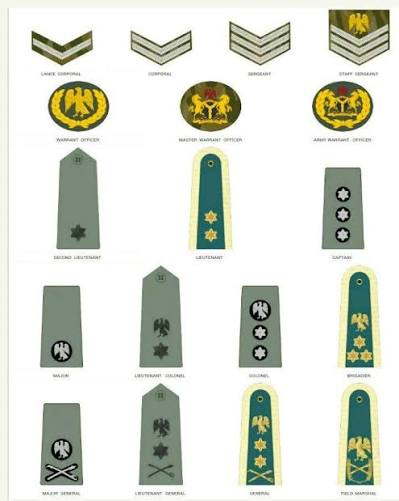
Military ranks of Nigeria and their equivalents
The Armed Forces of Nigeria—comprising the Nigerian Army, the Nigerian Navy, and the Nigerian Air Force—operate under a highly structured, unified grading framework. To ensure seamless joint operations, administrative alignment, and strategic command execution, the ranks across these three distinct branches are harmonized using a system of exact equivalents.
The military hierarchy is fundamentally split into two overarching groups: Commissioned Officers, who hold presidential commissions to lead, manage, and strategize, and Non-Commissioned Officers (NCOs) and Enlisted Personnel, who handle tactical, technical, and day-to-day operational execution.
Read also: Nigerian Navy AK Recruitment Apply Now
Military ranks of Nigeria and their equivalents
Commissioned officer ranks represent the executive leadership of the military. Their equivalent structure is categorized into junior officers, senior officers, and flag or general officers (the highest tiers of leadership).
The table below outlines the precise peer ranks across the three branches, ordered from the lowest entry rank to the highest achievable military status:
| Rank Grade | Nigerian Army | Nigerian Navy | Nigerian Air Force |
|---|---|---|---|
| Junior Officer | Second Lieutenant | Midshipman / Sub-Lieutenant (acting) | Pilot Officer |
| Junior Officer | Lieutenant | Sub-Lieutenant | Flying Officer |
| Junior Officer | Captain | Lieutenant | Flight Lieutenant |
| Senior Officer | Major | Lieutenant Commander | Squadron Leader |
| Senior Officer | Lieutenant Colonel | Commander | Wing Commander |
| Senior Officer | Colonel | Captain | Group Captain |
| General / Flag Officer | Brigadier General | Commodore | Air Commodore |
| General / Flag Officer | Major General | Rear Admiral | Air Vice Marshal |
| General / Flag Officer | Lieutenant General | Vice Admiral | Air Marshal |
| General / Flag Officer | General | Admiral | Air Chief Marshal |
| Supreme Officer | Field Marshal | Admiral of the Fleet | Marshal of the Nigerian Air Force |
Note: The ultimate tier (Field Marshal / Admiral of the Fleet / Marshal of the NAF) functions as an honorary or wartime five-star rank and is rarely attained in peacetime.
Non-Commissioned Officers and Enlisted Personnel Equivalents
Enlisted ranks represent the technicians, specialists, and combat troops who execute field operations. As personnel gain experience, passing marks on promotional exams, and time-in-service milestones, they rise through the non-commissioned officer brackets.
The structural equivalents for personnel below commission status are aligned as follows, ordered from fresh recruit to the highest non-commissioned officer tier:
| Nigerian Army | Nigerian Navy | Nigerian Air Force |
|---|---|---|
| Recruit / Private | Ordinary Seaman | Aircraftman / Aircraftwoman |
| Lance Corporal | Able Seaman | Leading Aircraftman |
| Corporal | Leading Seaman | Corporal |
| Sergeant | Petty Officer | Sergeant |
| Staff Sergeant | Not Applicable | Flight Sergeant |
| Warrant Officer | Chief Petty Officer | Warrant Officer |
| Master Warrant Officer | Master Warrant Officer | Master Warrant Officer |
| Army Warrant Officer | Navy Warrant Officer | Air Warrant Officer |
Note: The Navy does not maintain a direct standalone structural equivalent for the Army’s Staff Sergeant rank; instead, Navy personnel transition from Petty Officer duties upward toward Chief Petty Officer responsibilities.
Structural Significance of Equivalents
Maintaining clear equivalent ranks serves multiple vital institutional purposes within the Nigerian defense architecture:
- Joint Task Force Commands: During unified security operations—such as counter-insurgency campaigns or maritime border enforcement—officers from different branches must collaborate closely. Equivalent ranks instantly define the chain of command, ensuring a Major General in the Army can effectively lead a joint division alongside a Rear Admiral and an Air Vice Marshal.
- Unified Salary and Welfare Frameworks: The federal government utilizes consolidated pay scales, primarily the Consolidated Armed Forces Salary Structure (CONAFSS). Remuneration, hazard allowances, housing assignments, and post-service pensions are distributed evenly based on rank equivalence, regardless of the officer’s specific branch of service.
- Protocol and Etiquette: Military courtesy requires strict adherence to seniority. Knowing equivalents ensures that personnel from different arms can appropriately execute salute protocols and maintain discipline during joint military functions, national parades, and international missions.
Conclusion
The standardized alignment of military ranks across the Nigerian Army, Navy, and Air Force ensures that the nation’s armed services operate as a single, cohesive defensive unit. From the foundational level of Privates, Ordinary Seamen, and Aircraftmen up to the elite four-star general staff running the Ministry of Defence, this universal hierarchy keeps the chain of command clear, organized, and operationally efficient.










2 thoughts on “Military ranks of Nigeria and their equivalents”